National Philanthropy Day: Carleton grads on the power of philanthropy
November 15 is National Philanthropy Day, a day dedicated to celebrating the impact of giving and recognizing how leadership and collective action strengthen our communities. Two graduates of Carleton’s Masters in Nonprofit Leadership (MPNL) program reflect on the power of giving back and share how volunteerism and community engagement can cultivate meaningful change.
Q&A with Andrea Buttars (MPNL/24) – Vice-President, Philanthropic Services, Hamilton Community Foundation
Q: To start, tell us a little about your connection to Carleton — what did you study, when did you graduate, and what stands out most about your time at the university?
A: I completed the MPNL program part-time in a little over two years while working. My goal was to finish my master’s before my oldest child started university, and I accomplished that just in time!
What I enjoyed most was the range of knowledge I gained from different voices, including professors and instructors, guest speakers, and especially my fellow students. People in my classes were at different stages in their careers and lives with different experiences, and that brought such richness to the program.
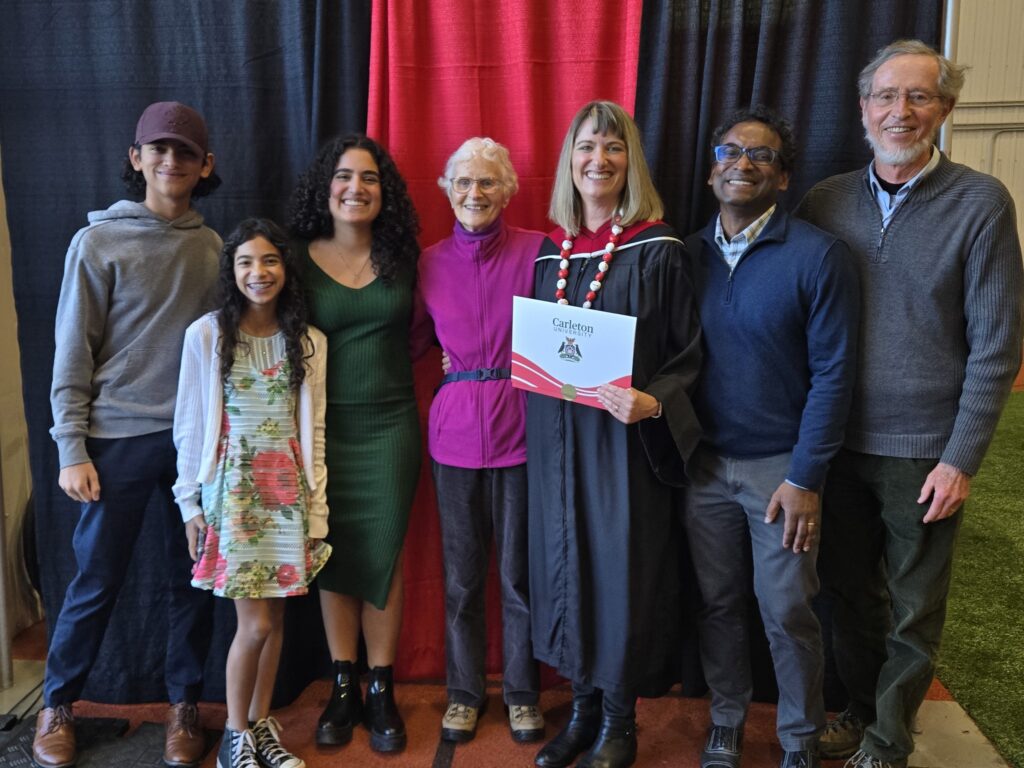
There was also a special family connection. My mom graduated from Carleton in 1965 with an undergraduate degree in sociology, and she came to my graduation. It was fun for her to see how much the university had changed, while also recognizing the things that had stayed the same. She was really proud of me for choosing to pursue my master’s at this point in my life.
Q: What inspired you to pursue the master’s program in Philanthropy and Nonprofit Leadership, and how did it shape your perspective on the role of philanthropy in society?
A: The biggest reason I wanted to do my master’s was that I wanted to better understand the nonprofit ecosystem I was working in. By that point, I had spent 10 years at a local education centre and 15 years at a social service agency.
I wanted to understand what changes I could help influence, as well as the broader changes organizations were experiencing. Sometimes charitable organizations can feel as though they’re the only ones going through something, whether it’s a shift in donor demographics, government funding or the needs of the people they support. Learning from academic research and individuals’ lived experiences helped me better understand the systems we’re working in and inform the strategic efforts I want to be part of.
Q: Was there a course, project, professor or mentor who had a lasting impact on you during your time in the program?
A: One of the most impactful experiences was a cross-listed course offered by Carleton University and Wits University in Johannesburg, South Africa.
It gave me an opportunity to learn about different perspectives on philanthropy. In North America, philanthropy has become quite professionalized and transactional, often focused on dollars. There is a lot of learning happening about what it really means to value gifts of time, knowledge and other forms of giving that are all incredibly important to creating change and helping charitable organizations operate.
I learned from students about the idea of mutual giving, including Ubuntu — the idea that you might help me now, and that support may be reciprocated in the future.
Q: What do you feel makes philanthropy such an important force for addressing challenges in society?
A: Philanthropy can create change and make an impact on an individual’s life or in a community. But larger systemic changes require everyone.

We need all levels of government, charitable organizations, grassroots groups and mutual aid — even people helping their neighbours. When we think about affordable housing, mental health crises and addictions, it’s clear that no single organization is going to create all the change that’s needed.
I think it’s important that people working in philanthropy don’t give the impression that our organization is going to do it all. That’s a disservice to the complexity of these issues, and it can create unrealistic expectations for donors and volunteers.
Charitable organizations and philanthropy absolutely have a significant impact on our communities and in people’s lives. At the same time, large-scale social change requires many different people and organizations at the table.
Q&A with Christian Robillard (BPAPM/16), (MPNL/18) – Account Executive, Blackbaud & Founder of Purpose Podcasting
Q: To start, tell us a little about your connection to Carleton — what did you study, when did you graduate, and what stands out most about your time at the university?

A: I completed my undergraduate degree in Public Affairs and Policy Management from 2011 to 2016 and then went straight into my master’s in Philanthropy and Nonprofit Leadership. Throughout that time, I was involved with the Student Philanthropy Council, and now I volunteer with the newly formed Master’s in Philanthropy and Nonprofit Leadership Alumni Association Chapter.
What stands out most to me about Carleton is the people. Whether it was the people sitting next to me in class, my professors, or the people working behind the scenes who became mentors and friends, there was just such a great atmosphere on campus.
Q: What inspired you to pursue the master’s program in Philanthropy and Nonprofit Leadership, and how did it shape your perspective on the role of philanthropy in society?
A: I’ve been connected to this sector in some way since around 2003, when I was attending a summer camp run by the Boys and Girls Club Ottawa. That was where the seed was planted in terms of what the philanthropic sector can do for people and with people, and the kind of impact and change it can ultimately have.
I knew that if I was going to pursue a master’s degree, I wanted to do something in this sector because I love it. I think it represents so much in terms of positive impact, and there’s been so much growth in its size, sophistication and willingness to be honest with itself about some of the challenges it faces. The program really opened my eyes to the size and scale of the sector. It employs so many people, contributes significantly to the economy, and touches so many different industries and aspects of our lives.
Q: Was there a course, project, professor or mentor who had a lasting impact on you during your time in the program?
A: One of the standouts for me was Dr. Tessa Hebb, who is one of the pioneers and leaders in Canada when it comes to social finance. Her teaching opened my eyes to the different ways private capital and resources can be put toward public purposes. It also showed me that there doesn’t necessarily have to be a trade-off between social good and business good. Something can make financial sense while also making a positive social impact.
For example, investing in an affordable housing project that helps people access affordable homes doesn’t have to come at the expense of an investor receiving a financial return. But one of the biggest lessons I took away from her teaching was that there will always be a role for philanthropy.
Q: What do you feel makes philanthropy such an important force for addressing challenges in society?
A: I really see philanthropy as an extension of and a safeguard for democracy. It’s about supporting and empowering the kinds of organizations, causes and work that ultimately make society better.
That could mean supporting an employment program that helps people facing barriers find work, helping someone reintegrate into society after going through the criminal justice system, or protecting wetlands and other sensitive conservation areas.
I really believe that philanthropy is something everyone can and should participate in, and I’d really emphasize that philanthropy isn’t just money. It’s the three T’s: your time, your talent, and your treasure. Philanthropy takes many forms; I think people should participate wherever they can.